Overview
3D user interfaces are already essential to fields
as diverse as visualization and video games, and are growing even
more important as personal computers and smartphones
incorporate increasingly powerful 3D technology and standalone VR and AR
headsets become consumer products. COMS W4172 provides
an introduction to this exciting way of interacting with computers,
with an emphasis on methods for designing and developing effective 3D
user interfaces. The course's name acknowledges the major role played
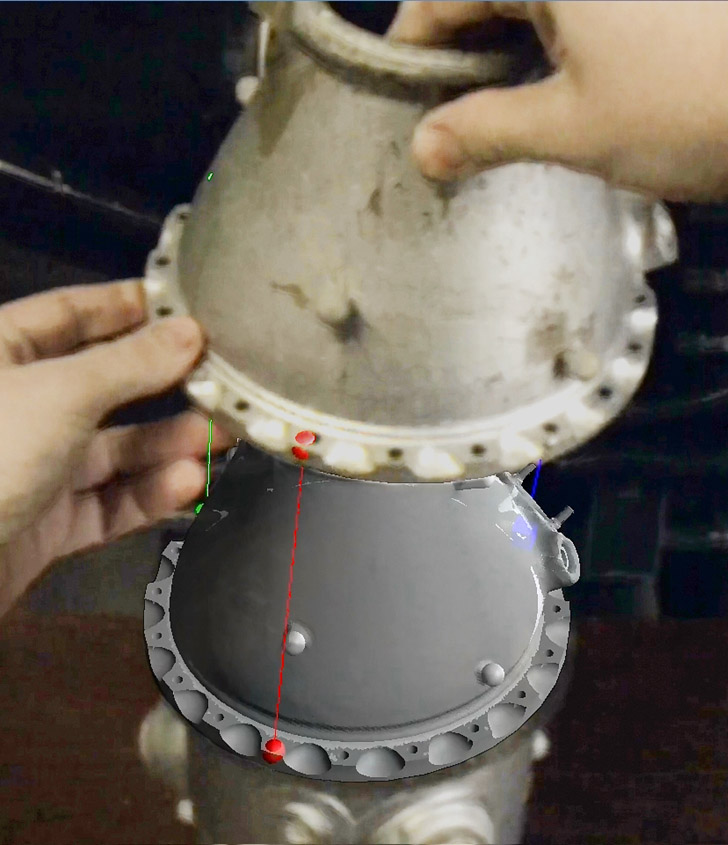
in our projects by augmented reality—dynamically integrating
spatially registered 3D virtual media with our experience of the real
world. We will explore:
- Metaphors for 3D user interfaces, from desktop to
immersive, including augmented reality and virtual reality.
- 3D perception, displays, and
interaction and tracking technology.
- Selecting 3D objects.
- Manipulating 3D objects through translation,
scaling, and rotation.
- Traveling and wayfinding to get from one real or
virtual place to another, and to understand where you are and where
you can go.
- System control, from menus to multimodal
interaction.
- Symbolic input, such as text.
Your grade will be based on:
- Individual assignments (60%, broken down into 15%
for an introductory program + 15% for the evaluation of a 3D user
interface + 30% for the design and development of an application
built around a set of 3D interaction techniques), and
- A team design and development project (40%).
There will be no final exam, but we hope you'll be
having too much fun doing the final project to miss it.
Prerequisites are at least one of the following:
- COMS W4160 (Computer Graphics), or
- COMS W4170 (User Interface Design), or
- COMS E6998 (Topics in VR and AR), or
- a strong desire to learn about 3D user interfaces
and permission of the instructor.
Please don't hesitate to talk with me to find out if
this is the right course for you! Prior familiarity with the 3D math
used in COMS W4160 will be helpful, but is not required: the
course will include a review of the 3D math needed to understand the
material and do the assignments.
Professor
Steve
Feiner (feiner [AT] cs [DOT] columbia [DOT] edu) is a Professor of
Computer Science and director of the Computer
Graphics and User Interfaces Lab. He is interested in most aspects
of human–computer interaction and computer graphics, with special
emphasis on interactive 3D user interfaces, virtual and augmented
reality, mobile and wearable computing, hybrid user interfaces that
combine different display and interaction technologies, automated design
of graphics and multimedia, computer games, healthcare applications, and
information visualization (i.e., “fun stuff”). He will hold
office hours right after class (other hours by appointment—please don't hesitate to
email). He will usually stay after class for as long
as it takes to answer any questions you have.
Instructional Assistants
Ben Yang (by2297
[AT] columbia [DOT]) is a CS PhD student in the Computer Graphics and User
Interfaces Lab. He is interested in synthesizing all types of biometric
information for building immersive 3D user interfaces and AR/VR
applications. His research investigates how eye and hand tracking can be
used to make collaborative environments more immersive for users. His
office hours will be Thursdays 11am–noon in 6LE3 CEPSR.
Siddharth
Ananth (sa4287 [AT] columbia [DOT]) is a MS in CS student. His
research interests are focused on using AR and VR to enhance
training and task guidance. He is working on a project
that uses standalone VR headsets (Quest 2 and 3) to help
medical students learn how to perform a lumbar puncture on an infant.
He is also interested in building user interfaces to
guide multitasking. His office hours will be Mondays
3pm–4pm in the CS IA room.
Readings
J. LaViola Jr., E. Kruijff, R. McMahan, D. Bowman,
and I. Poupyrev. 3D User Interfaces: Theory and Practice, 2nd
Edition. Addison-Wesley, Boston, 2017, ISBN-13
978-0-13-403432-4 [required].
D. Schmalstieg and T. Höllerer. Augmented
Reality: Principles and Practice. Addison-Wesley, Boston, 2016,
ISBN-13 978-0-32-188357-5 [required].
Additional reading material will be announced in the
syllabus and in class.
Computing Environment
For those assignments that involve programming, we
will use Unity (initially Unity
2022.3 LTS, possibly progressing to later versions as the semester unfolds),
which supports the development of 3D applications for desktop,
hand-held, and head-worn displays. To enable augmented reality, in
which the user's perception of the surrounding real world is
integrated with geometrically aligned 3D media, we will rely on
Unity
AR Foundation, which can track the position and orientation of
printed images, can detect planar surfaces in the environment,
and can determine their position and orientation, when run on appropriate Android or iOS devices.
You will be deploying your apps to your own handheld
Android or iOS device with a camera (a smartphone or tablet) or a
Meta Quest 2 or 3 headset
that we will provide if you don't have your own.
For additional information, please see the following documentation that we've prepared for the course:
CS W4172 IA Resource Page,
Installing Unity, and
Developing with Unity.
Rules of the Game
You are responsible for all material covered in
class and all the assigned reading listed in the syllabus, including
any changes or additions announced in class. If you miss a class,
please talk to someone who didn't. (Copies of each class's slides will
be linked to the syllabus.)
Course material will be found on the web through
CourseWorks, and the syllabus and assignments will be linked through
http://graphics.cs.columbia.edu/courses/csw4172/.
Submission Policy
Each assignment should be submitted electronically
through CourseWorks, before the beginning of the class (1:10pm) on the
day the assignment is due. If you don't submit an assignment on time,
the following lateness policy applies.
Lateness Policy
All assignments are due at 1:10pm on the
scheduled due date before, not during or after, class. To
make the deadlines more manageable, each student will be allowed
four “late days” during the semester for which lateness will not be
penalized. However, no late days may be applied to the final
project, and only one late day may be applied to the first
assignment. Otherwise, your four late days may be used as you see
fit. You don't need to tell us when you'll be using a late
day—we'll know because of when your assignment is submitted.
Anything turned in past the start of class
until midnight the next day is one day late. Every (partial)
day thereafter, up until the next midnight, that an assignment is late, including weekends and
holidays, counts as an additional late day.
Absolutely no late work will be
accepted beyond that accounted for by your late days. If you're not
done on time, please be sure to turn in whatever you have completed
on time to receive partial credit. Now, please go back and
read this section over again!
Academic Honesty Policy
Please make sure that you have read the Department
of Computer Science Policies
and Procedures Regarding Academic Honesty. Collaboration on any
assignment (except as an approved part of team projects) is, as in all
Columbia courses, strictly prohibited. Infractions will
be reported to the Department of Computer Science Academic Committee
and referred to the Deans.
For example, this means that if you use GitHub
(or any similar facility) to maintain material for an individual or
team assignment, you must use a private repository
whose access is appropriately restricted.
Similarly, videos should also be protected.